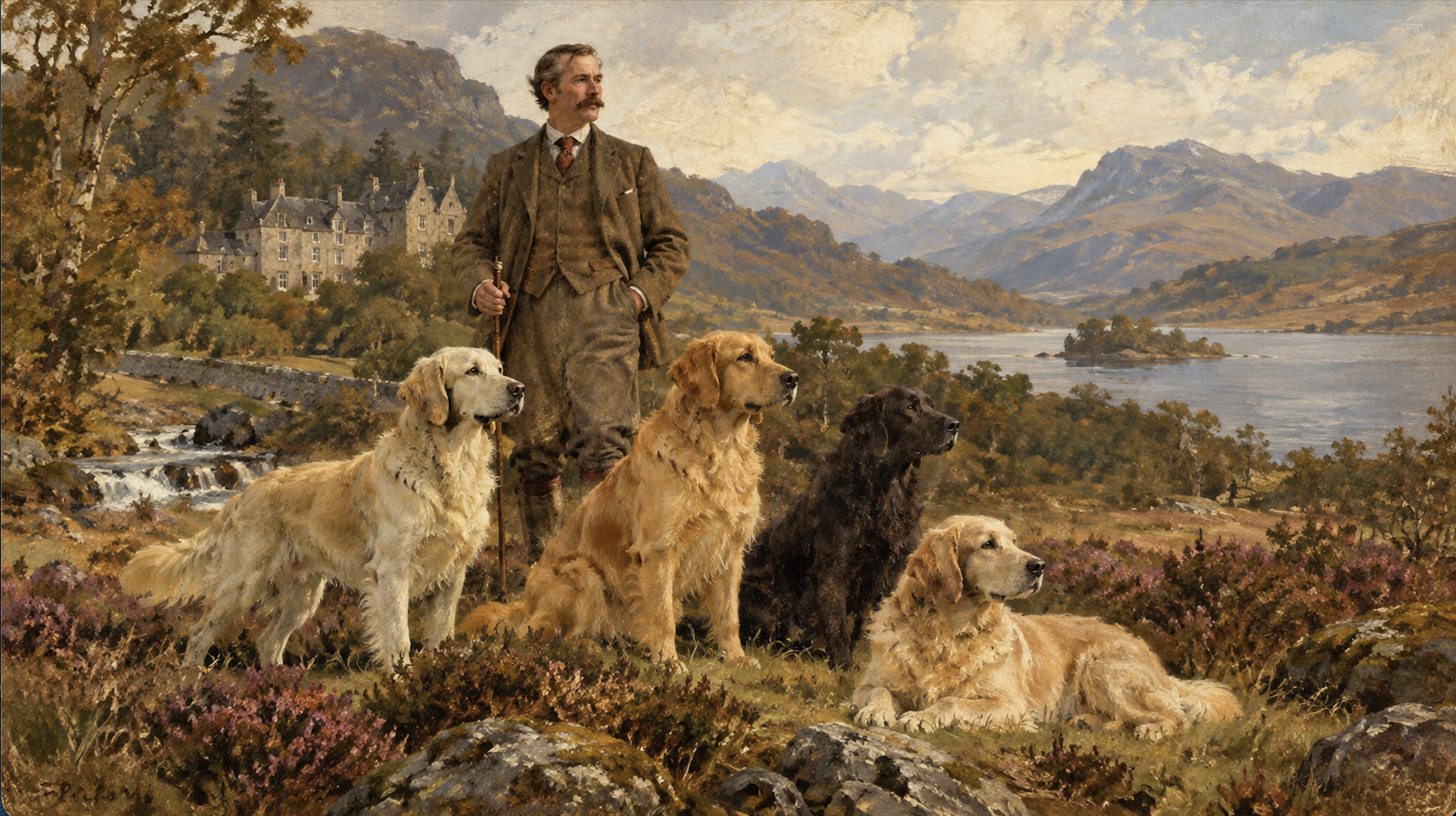
THE HISTORY OF THE GOLDEN RETRIEVER
The Golden Retriever originated in Scotland in the 19th century, with the development of the breed we know today closely associated with Dudley Marjoribanks, later known as Lord Tweedmouth, and his Guisachan estate in the Scottish Highlands. Unlike many breeds whose origins are difficult to trace, much of the Golden Retriever’s early development was documented in breeding records kept at Guisachan. And one of the most important dogs in that story was a yellow retriever named Nous.
LORD TWEEDMOUTH AND GUISACHAN
Dudley Marjoribanks acquired Guisachan, his Scottish estate, in the 1850s. Like many sportsmen of his time, he was interested in developing capable hunting and retrieving dogs. The Scottish countryside demanded a versatile retriever. The dog needed to work across rugged terrain, retrieve game from both land and water, carry it gently, and work closely with its handler. Marjoribanks selectively bred dogs with those characteristics, keeping detailed records of his breeding program. Those records eventually provided historians with an unusually detailed account of the development of the Golden Retriever.
NOUS AND BELLE: THE HISTORIC 1868 LITTER
In the 1860s, Marjoribanks acquired Nous, a distinctive yellow retriever from Wavy-Coated Retriever stock. Yellow retrievers were unusual at a time when black retrievers were much more common. Marjoribanks eventually bred Nous to Belle, a Tweed Water Spaniel. The Tweed Water Spaniel—now extinct—was associated with the River Tweed region and valued for its retrieving ability in water. In 1868, Nous and Belle produced four yellow puppies: Cowslip, Primrose, Crocus, and Ada. Their descendants became foundational to the development of the Golden Retriever.
WHAT BREEDS CREATED THE GOLDEN RETRIEVER?
The Golden Retriever wasn't created from a single cross. Although the 1868 breeding of Nous and Belle established the foundational line, Lord Tweedmouth continued selectively breeding their descendants over the following decades. Historical breeding records document additional retriever and Tweed Water Spaniel blood, along with Irish Setter and later sandy-colored Bloodhound ancestry. The goal wasn't simply to produce a beautiful golden-colored dog. These dogs were bred to work. They needed intelligence, athleticism, retrieving ability, a willingness to learn, and the temperament to cooperate closely with people. More than 150 years later, many of those traits are still easy to recognize in Golden Retrievers. Their love of retrieving, swimming, exploring, learning new things, and simply being with their people all connect back to what the breed was originally developed to do.
THE RUSSIAN CIRCUS DOG MYTH
For many years, a very different story circulated about the origin of the Golden Retriever. According to the story, Lord Tweedmouth purchased a group of performing dogs from a Russian circus and used them to establish the breed. It's an interesting story, but the historical records don't support it. Lord Tweedmouth's breeding records instead document Nous, Belle, their 1868 litter, and the generations of selective breeding that followed. Today, the Russian circus dog story is regarded as a historical myth rather than the documented origin of the Golden Retriever.
FROM SCOTTISH RETRIEVER TO BELOVED FAMILY DOG
By the beginning of the 20th century, these yellow retrievers were becoming established beyond Guisachan. In 1911, Britain's Kennel Club recognized them as a separate variety known as “Yellow or Golden.” Eventually, “Yellow” was dropped and the name Golden Retriever became established. Golden Retrievers soon made their way across the Atlantic. The first Golden Retriever was registered with the American Kennel Club in 1925, and the Golden Retriever Club of America was established in 1938. The breed's role also expanded far beyond hunting. The intelligence, trainability, athleticism, retrieving ability, and desire to work closely with people that made Goldens excellent sporting dogs also helped them succeed in service work, therapy, search and rescue, obedience, dog sports, and countless other roles. But for most Golden Retriever owners today, their most important role is much simpler: family.
WHERE DO ENGLISH GOLDEN RETRIEVERS FIT INTO THE HISTORY?
English Golden Retrievers don't have a separate origin story. Whether someone describes a Golden today as American, English, British-style, European-line, or English Cream, they are all Golden Retrievers and share the breed's historical roots. Over generations, different breeding populations and breed standards have contributed to some differences in appearance. British- and European-influenced Goldens are often associated with broader heads, substantial builds, and coats that may range into very light shades of cream.
At Southern Goldens, we love the appearance of our English and European-line Goldens, but understanding the history of the breed reminds us that a Golden Retriever has always been about much more than color. These dogs were developed to be intelligent, capable, trainable, and closely connected to people. Those are qualities worth preserving.